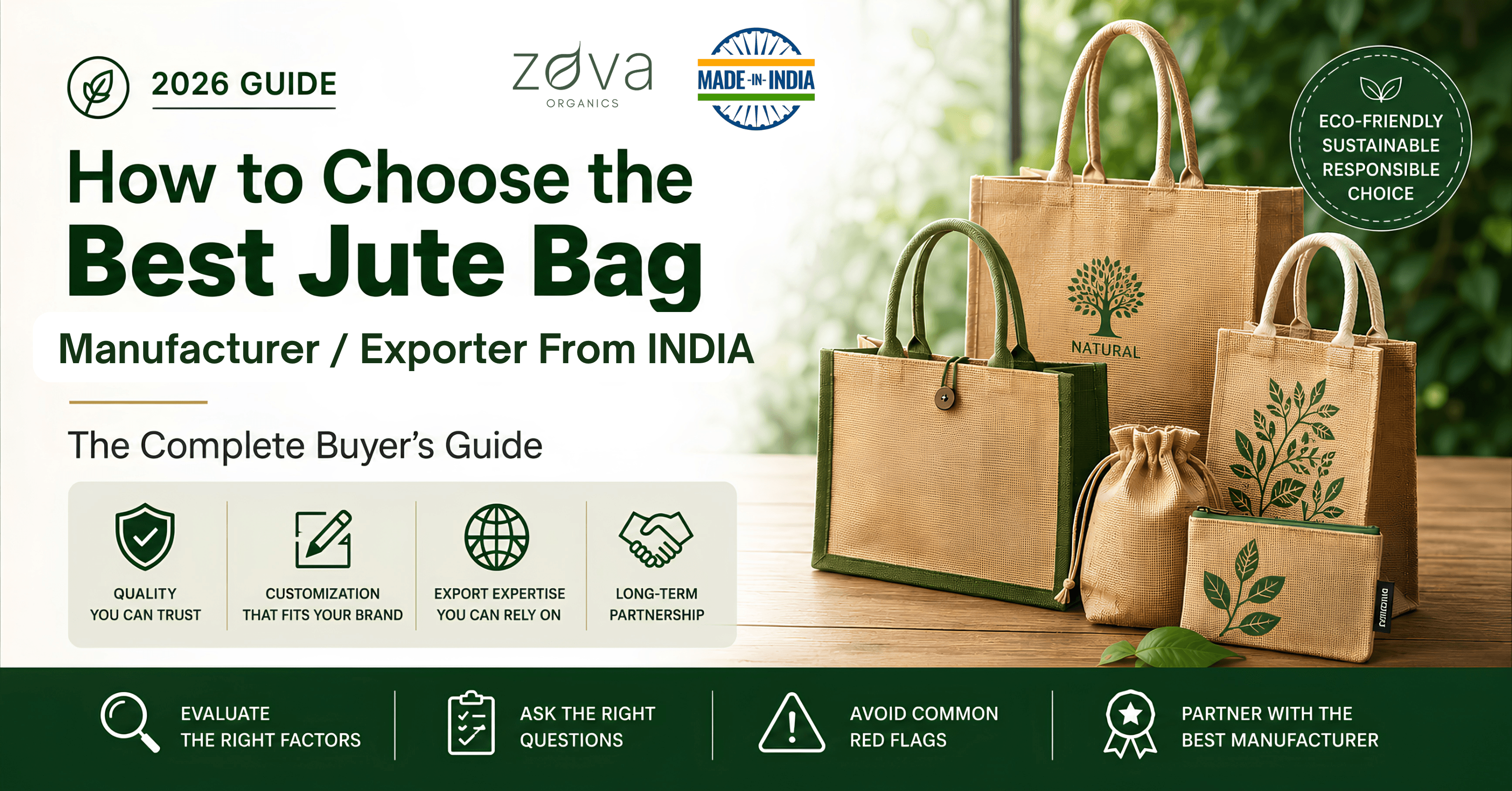
How to Choose the Best Jute Bag Manufacturer in India: The Complete Buyer's Guide (2026) | Zova Organics
industry-news
How to Choose the Best Jute Bag Manufacturer in India: The Complete Buyer's Guide (2026)
July 14, 202645 min read
How to Choose the Best Jute Bag Manufacturer in India: The Complete Buyer's Guide (2026)
If you're planning to source eco-friendly jute bags for your retail brand, supermarket chain, promotional campaign, or wholesale business, choosing the right manufacturer is one of the most important decisions you'll make.
India has long been recognized as one of the world's leading producers of jute and jute-based products. Its established manufacturing ecosystem, skilled workforce, and strong export capabilities make it a preferred sourcing destination for businesses worldwide. However, not every supplier offers the same level of product quality, customization, reliability, or export experience.
This guide explains how to evaluate jute bag manufacturers, compare suppliers, identify potential risks, and select an export partner that aligns with your quality standards and long-term business goals.
Whether you're a first-time importer or an experienced sourcing professional, you'll find practical advice to help you make informed purchasing decisions.
Quick Answer
The best jute bag manufacturer in India is not simply the one offering the lowest price. The right partner consistently delivers high-quality products, provides transparent communication, offers flexible customization, maintains reliable production capacity, follows quality control processes, and has proven experience exporting to international markets.
Before placing a bulk order, evaluate the manufacturer's product quality, export expertise, certifications, customization capabilities, production timelines, and after-sales support. Requesting product samples and verifying manufacturing standards can significantly reduce sourcing risks.
Key Takeaways
India remains one of the leading global sourcing destinations for jute bags.
A reliable manufacturer should demonstrate consistent quality, export experience, and transparent communication.
Product quality and long-term reliability generally have a greater impact on business success than choosing the lowest-priced supplier.
Sampling, quality inspections, and clear production agreements help reduce costly mistakes.
Businesses looking for private-label or custom-branded jute bags should evaluate design capabilities as carefully as manufacturing quality.
Table of Contents
Why Businesses Source Jute Bags from India
Why Choosing the Right Manufacturer Matters
Types of Jute Bag Manufacturers
How to Evaluate a Manufacturer
Questions Every Buyer Should Ask
Common Red Flags to Avoid
Expert Insights from Zova Organics
Why India Is a Global Leader in Jute Bag Manufacturing
India has developed one of the world's most established ecosystems for jute cultivation, processing, and manufacturing. Decades of expertise, abundant raw material availability, and a mature export infrastructure have enabled Indian manufacturers to supply jute bags to businesses across North America, Europe, the Middle East, Asia, and Oceania.
This strong supply chain benefits international buyers in several ways.
Access to High-Quality Raw Material
The quality of a finished jute bag depends heavily on the raw fiber used during production. Manufacturers with access to consistent, high-quality jute can produce bags with better strength, durability, texture, and appearance.
High-grade raw materials also improve printing quality, stitching performance, and overall product longevity.
Extensive Product Range
Leading manufacturers typically offer a broad portfolio, allowing buyers to source multiple product types from a single supplier.
Common categories include:
Shopping bags
Grocery bags
Promotional bags
Corporate gifting bags
Beach bags
Wine bottle bags
Drawstring bags
Laminated jute bags
Fashion tote bags
Conference bags
Exhibition bags
Private-label collections
For buyers managing multiple product lines, this reduces the need to coordinate with several vendors.
Advanced Customization Capabilities
Today's buyers increasingly expect products that reflect their own brand identity rather than generic stock designs.
Experienced manufacturers often provide:
Custom dimensions
Fabric weight options
Colored jute fabrics
Cotton or rope handles
Screen printing
Offset printing
Digital printing
Embroidery
Woven labels
Hang tags
Individual packaging
Barcode labeling
Retail-ready packaging
These capabilities enable businesses to create distinctive, market-ready products.
Established Export Infrastructure
Exporting involves far more than manufacturing. A dependable supplier should also understand international documentation, packaging standards, shipping coordination, and communication throughout the order lifecycle.
Manufacturers with established export experience are generally better prepared to support overseas buyers and minimize delays.
Why Choosing the Right Manufacturer Matters
Selecting a manufacturer is about more than comparing prices. The supplier you choose will directly influence product quality, customer satisfaction, delivery reliability, and ultimately your brand reputation.
A dependable manufacturing partner contributes to:
Consistent product quality
Reliable production schedules
Fewer shipment issues
Better communication
Lower defect rates
Stronger customer confidence
Long-term sourcing stability
By contrast, working with an unreliable supplier can lead to inconsistent quality, missed deadlines, and increased operational costs.
Understanding the Different Types of Jute Bag Suppliers
Not every company involved in the jute bag industry performs the same role. Understanding these differences helps buyers identify the most suitable sourcing partner.
Supplier Type
Best For
Considerations
Manufacturer
Buyers seeking production capabilities and customization
Greater control over quality and specifications
Exporter
Businesses requiring international shipping support
Often combines manufacturing and export expertise
Trading Company
Buyers looking for a wider product selection
May outsource production to multiple factories
OEM Manufacturer
Private-label brands
Produces products under the buyer's brand
ODM Manufacturer
Buyers seeking ready-made designs
Faster development but less product exclusivity
For businesses that value quality consistency and branding flexibility, working directly with an experienced manufacturer or manufacturer-exporter is often the preferred approach.
How to Evaluate a Jute Bag Manufacturer
Many suppliers present polished websites and attractive catalogs. However, appearance alone doesn't reveal how well a company performs in production.
A structured evaluation process can help buyers identify dependable partners.
Manufacturing Experience
Look for companies with a proven track record in producing jute bags for international markets. Experience often reflects established production systems and familiarity with buyer expectations.
Questions to ask include:
How many years have you been manufacturing jute bags?
Which export markets do you currently serve?
What industries do your customers operate in?
Can you provide examples of previous projects?
Product Quality
Quality should be assessed systematically rather than visually alone.
Inspect areas such as:
Fabric consistency
Stitch density
Reinforced handles
Edge finishing
Lamination quality (if applicable)
Printing accuracy
Color consistency
Overall craftsmanship
Requesting physical samples before confirming a bulk order remains one of the most effective ways to evaluate product quality.
Production Capacity
Manufacturing capability should align with your purchasing requirements.
Key considerations include:
Monthly production capacity
Ability to handle seasonal demand
Production scalability
Lead times for repeat orders
Businesses planning long-term sourcing relationships should ensure their supplier can support future growth.
Communication and Responsiveness
Reliable communication is often an early indicator of how smoothly a project will progress.
Evaluate whether the supplier:
Responds promptly
Answers questions clearly
Provides accurate quotations
Explains production timelines
Shares realistic delivery schedules
Transparent communication helps build confidence throughout the sourcing process.
Expert Insight from Zova Organics
One of the most common mistakes first-time buyers make is evaluating suppliers based primarily on price.
Lower quotations may reflect differences in fabric quality, stitching standards, printing methods, or finishing processes. These differences often become apparent only after the shipment arrives, when replacing defective products can be expensive and time-consuming.
Instead of selecting a supplier solely because they offer the lowest price, compare the overall value they provide. Factors such as consistent quality, customization expertise, reliable communication, and dependable export support often have a greater impact on long-term business success.
Buyer Checklist: Before Contacting a Manufacturer
Preparing the right information before reaching out to suppliers can help you receive more accurate quotations and recommendations.
Consider defining:
Intended use of the bags
Preferred dimensions
Estimated order quantity
Printing requirements
Fabric preferences
Handle style
Packaging requirements
Destination country
Expected delivery timeline
Budget expectations
Providing these details upfront allows manufacturers to propose solutions that better match your needs.
How to Evaluate, Compare, and Select the Best Jute Bag Manufacturer in India
Verify the Manufacturer's Export Experience
Manufacturing high-quality jute bags is only one part of a successful export partnership. International buyers should also evaluate whether a supplier has experience handling overseas orders, preparing export documentation, coordinating logistics, and communicating effectively throughout the production cycle.
Ask potential suppliers questions such as:
Which countries do you currently export to?
What percentage of your business comes from exports?
Have you supplied retailers, wholesalers, distributors, or private-label brands?
Which shipping terms (Incoterms) do you regularly offer?
Can you coordinate with freight forwarders?
Manufacturers with established export experience are generally better equipped to anticipate documentation requirements, packaging standards, and shipping timelines, helping reduce the risk of costly delays.
Check Certifications and Compliance
Depending on your target market and customer requirements, certifications may play an important role in supplier selection.
Common certifications and compliance standards include:
Certification / Standard
Why It Matters
ISO 9001
Demonstrates a structured quality management system.
OEKO-TEX (where applicable)
Indicates testing for harmful substances in textile components.
REACH Compliance
Important for many products entering European markets.
FSC Certified Paper Packaging (if paper inserts are used)
Supports responsible sourcing claims.
Social Compliance Audits (such as BSCI or SEDEX, where applicable)
Demonstrates commitment to ethical manufacturing practices.
Not every buyer requires every certification. Instead, determine which standards are relevant to your destination market and product requirements.
Evaluate Product Quality Beyond Appearance
A visually attractive bag is not necessarily a well-manufactured one. Product quality should be assessed through a combination of physical inspection and technical specifications.
When reviewing samples, inspect:
Fabric Quality
Uniform weave
Consistent texture
Appropriate GSM for the intended use
Minimal fiber shedding
Stitching
Look for:
Straight stitch lines
Reinforced stress points
No loose threads
Even seam spacing
Poor stitching is one of the most common causes of bag failure.
Handle Strength
Evaluate:
Stitch reinforcement
Handle alignment
Comfort
Weight-bearing capability
A premium-looking bag with weak handles can negatively affect your customer's experience.
Printing Quality
Check for:
Sharp logo edges
Accurate color reproduction
Smudge resistance
Registration accuracy
Durability after handling
Understanding Jute Fabric GSM
Many first-time buyers compare quotations without realizing that fabric weight significantly affects pricing and durability.
GSM Range
Typical Application
250–300 GSM
Lightweight promotional bags
310–350 GSM
Everyday shopping bags
350–420 GSM
Premium retail bags
420+ GSM
Heavy-duty reusable bags
Choosing the appropriate GSM depends on the intended application, expected load capacity, and desired product positioning.
Customization Capabilities to Look For
One of India's key advantages is its ability to manufacture customized jute bags for international brands.
Evaluate whether the supplier can provide:
Size Customization
Custom width
Custom height
Custom gusset
Special dimensions
Material Options
Natural jute
Dyed jute
Laminated jute
Cotton-jute combinations
Handle Options
Cotton tape handles
Padded handles
Rope handles
Bamboo handles
Leather-look handles (where applicable)
Branding Options
Screen printing
Heat transfer
Digital printing
Embroidery
Woven labels
Hang tags
Packaging
Ask whether the manufacturer can supply:
Individual polybags (if required)
Barcode labels
Retail-ready cartons
Private-label packaging
Customized shipping marks
For retailers and private-label brands, packaging quality is often as important as the product itself.
Understanding Minimum Order Quantity (MOQ)
Minimum Order Quantity (MOQ) refers to the smallest order a manufacturer is willing to produce.
MOQ can vary depending on:
Bag style
Printing requirements
Fabric color
Production complexity
Packaging specifications
Rather than searching for the lowest MOQ, buyers should focus on finding a supplier whose production capabilities match their business objectives.
How Pricing Is Determined
One of the most common misconceptions is that jute bags have a standard market price.
In reality, pricing depends on multiple variables.
Factors That Influence Price
Fabric GSM
Bag dimensions
Printing complexity
Number of print colors
Handle type
Lamination
Labels and accessories
Packaging
Order quantity
Shipping terms
For this reason, comparing quotations without confirming identical specifications can lead to misleading conclusions.
Price vs. Value: A Buyer's Perspective
A supplier offering the lowest unit price may not always provide the best overall value.
Consider the following comparison:
Lowest Price Supplier
Value-Focused Manufacturer
Lower initial cost
Better long-term reliability
Basic quality control
Consistent manufacturing standards
Limited customization
Broad customization capabilities
Higher defect risk
Lower return rates
Potential shipment delays
Reliable production schedules
Short-term savings
Stronger brand reputation
For businesses building long-term customer relationships, consistent quality often delivers greater value than the lowest purchase price.
Questions Every Importer Should Ask Before Placing an Order
Before confirming a supplier, ask these questions:
Manufacturing
Are you the manufacturer or a trading company?
Can you produce custom sizes?
What is your monthly production capacity?
Quality
How is quality inspected during production?
Do you conduct final inspections before shipment?
Can you provide production samples?
Printing
Which printing techniques do you offer?
How do you ensure color consistency?
Can you match Pantone colors?
Logistics
Which Incoterms do you support?
Can you arrange sea freight?
What documents will you provide?
Payment
What payment terms do you accept?
Are milestone payments available?
Common Red Flags to Watch For
While many manufacturers are highly professional, buyers should remain cautious if they notice:
Extremely low quotations without explanation.
Reluctance to provide product samples.
Inconsistent communication.
Unrealistic production timelines.
Incomplete quotations.
No clear quality assurance process.
Limited willingness to answer technical questions.
These issues do not automatically indicate a poor supplier, but they warrant additional due diligence before placing a significant order.
Expert Insight from Zova Organics
Many buyers compare suppliers using only two factors: price and delivery time.
In practice, the most successful sourcing partnerships are built on four pillars:
Consistent product quality.
Transparent communication.
Reliable delivery performance.
Flexibility in customization.
A supplier who performs well across all four areas is often better positioned to support long-term business growth than one offering the lowest initial quotation.
Choosing the best jute bag manufacturer involves more than requesting quotations. Buyers should evaluate technical quality, export capabilities, customization options, communication standards, production capacity, and long-term reliability. Taking the time to compare suppliers systematically can reduce sourcing risks and contribute to stronger customer satisfaction and business growth.
Shipping, Documentation, Quality Assurance, and Final Buyer's Checklist
Understanding Shipping Options
Choosing the right shipping method affects delivery timelines, logistics costs, inventory planning, and customer satisfaction.
The two most common options for international jute bag shipments are sea freight and air freight.
Sea Freight
Sea freight is generally the preferred option for wholesale orders because it offers the lowest transportation cost per unit.
Best for:
Bulk imports
Retail chains
Wholesalers
Distributors
Long-term inventory planning
Advantages
Lower shipping costs
Suitable for full container (FCL) and less-than-container (LCL) shipments
Better profitability on large orders
Considerations
Longer transit times
Requires advance inventory planning
Air Freight
Air freight is typically used when speed is more important than shipping cost.
Best for:
Product samples
Urgent replenishment
Product launches
Small-volume shipments
Advantages
Faster delivery
Reduced lead time
Considerations
Higher transportation cost
Less economical for large-volume orders
Understanding Common Incoterms
Incoterms define the responsibilities of buyers and sellers during international trade.
Choosing the appropriate Incoterm helps prevent misunderstandings regarding transportation costs, insurance, customs clearance, and delivery obligations.
Incoterm
Seller Responsibility
Buyer Responsibility
Suitable For
EXW
Goods available at factory
Almost all logistics
Experienced importers
FOB
Seller delivers goods to port and loads vessel
Ocean freight, insurance, import clearance
Most international buyers
CIF
Seller arranges freight and insurance to destination port
Import clearance and local delivery
Buyers seeking simplified shipping
DDP
Seller manages nearly the entire delivery process
Receive shipment
Buyers wanting maximum convenience
For many first-time importers, FOB (Free on Board) offers a good balance between cost control and logistics flexibility. Businesses new to international sourcing should discuss Incoterm options with both their supplier and freight forwarder before placing an order.
Essential Export Documents
Accurate documentation is essential for customs clearance and smooth international trade.
Your supplier should typically provide:
Commercial Invoice
Packing List
Bill of Lading (Sea Freight)
Air Waybill (Air Freight)
Certificate of Origin (if required)
Insurance Documents (when applicable)
Export Declaration
Depending on the destination country, additional documentation may be required. Buyers should verify import requirements with their customs broker before shipment.
Quality Inspection Before Shipment
One of the most effective ways to reduce sourcing risk is to perform a pre-shipment inspection before goods leave the factory.
A structured inspection can help identify issues while corrective action is still possible.
What Should Be Inspected?
Product Dimensions
Confirm:
Width
Height
Gusset depth
Handle length
Stitching Quality
Inspect:
Reinforced stress points
Seam consistency
Loose threads
Handle attachment
Printing Accuracy
Verify:
Logo placement
Brand colors
Alignment
Print clarity
Ink consistency
Material Consistency
Evaluate:
Fabric weight
Weave quality
Lamination consistency
Surface finish
Packaging
Confirm:
Carton labeling
Quantity per carton
Shipping marks
Barcode labels
Retail packaging (if applicable)
A detailed quality inspection before shipment is often less expensive than resolving product issues after arrival.
Common Mistakes First-Time Buyers Make
Many sourcing challenges can be avoided with proper planning.
Choosing the Lowest Quote
Price is important, but unusually low quotations may reflect differences in material quality, construction, or production processes.
Ordering Without Samples
Always request and evaluate production samples before confirming a bulk order.
Ignoring Lead Times
Production, quality inspections, shipping, and customs clearance all require time. Plan purchases well in advance of seasonal demand.
Incomplete Product Specifications
Provide detailed specifications for:
Dimensions
GSM
Printing
Handles
Packaging
Labels
Clear specifications reduce misunderstandings during production.
Skipping Final Inspection
Even experienced buyers benefit from verifying production quality before shipment.
Buyer's Procurement Checklist
Use this checklist before placing your order.
Supplier Evaluation
☐ Manufacturing experience verified
☐ Export experience confirmed
☐ Communication satisfactory
☐ Product samples approved
☐ Production capacity suitable
Product Specification
☐ Dimensions confirmed
☐ GSM confirmed
☐ Handle style approved
☐ Printing artwork finalized
☐ Packaging approved
Commercial Agreement
☐ Unit pricing confirmed
☐ MOQ agreed
☐ Production timeline confirmed
☐ Payment terms agreed
☐ Incoterms selected
Logistics
☐ Shipping method selected
☐ Freight forwarder appointed
☐ Customs requirements reviewed
☐ Documentation confirmed
Frequently Asked Questions
Which country is best for sourcing jute bags?
India is widely recognized as one of the leading sourcing destinations due to its established manufacturing base, abundant raw material, skilled workforce, and strong export infrastructure. The best choice ultimately depends on your quality, customization, and supply chain requirements.
Can manufacturers produce custom-designed jute bags?
Yes. Many manufacturers offer custom dimensions, logo printing, fabric colors, handle options, labels, and retail packaging for private-label brands.
What is the typical production lead time?
Lead times vary depending on order size, customization, and seasonal demand. Buyers should confirm production schedules before placing an order.
Can I order samples before placing a bulk order?
Yes. Requesting samples is a recommended practice, allowing buyers to evaluate product quality, printing, stitching, and overall workmanship before committing to a larger purchase.
Which shipping method is better?
Sea freight is generally more economical for bulk shipments, while air freight is suitable for urgent deliveries or sample orders.
How do I know if a manufacturer is reliable?
Evaluate export experience, communication quality, product samples, production capacity, customization capabilities, and references. A structured supplier assessment is more reliable than comparing prices alone.
Do I need a freight forwarder?
Most importers use a freight forwarder to coordinate transportation, documentation, and customs procedures, particularly for sea freight shipments.
Can manufacturers help with private-label products?
Many Indian manufacturers support private-label programs, including custom printing, branded packaging, and product specifications tailored to the buyer's requirements.
Expert Insight from Zova Organics
Successful sourcing partnerships are built over time.
The strongest relationships are those where buyers and manufacturers communicate openly, establish clear quality expectations, and treat each order as the beginning of a long-term collaboration rather than a single transaction.
A reliable manufacturing partner should be able to grow alongside your business by supporting new product development, seasonal demand, custom branding, and consistent production quality.
Why Businesses Choose Zova Organics
At Zova Organics, we specialize in exporting premium eco-friendly jute bags for businesses worldwide.
We work with:
Importers
Wholesalers
Retail chains
Promotional product companies
Corporate gifting businesses
Supermarkets
Sustainable brands
Private-label businesses
Our focus is on delivering:
High-quality manufacturing
Custom branding solutions
Flexible product development
Consistent quality control
Transparent communication
Reliable export support
Sustainable manufacturing practices
Whether you're launching a new eco-friendly product line or expanding an existing range, our team is committed to helping you source jute bags that align with your quality standards and brand objectives.
Final Thoughts
Choosing the best jute bag manufacturer in India is not simply about finding the lowest quotation. It involves evaluating product quality, manufacturing capability, export experience, customization options, communication standards, and long-term reliability.
By following a structured supplier evaluation process, requesting samples, verifying quality, and planning logistics carefully, businesses can reduce sourcing risks and build stronger, more resilient supply chains.
As global demand for sustainable packaging continues to grow, selecting the right manufacturing partner today can create lasting value for your business tomorrow.